This year’s Wimbledon closed with two very different champions and one shared truth. Jannik Sinner defended his crown with the calm of a world No.1 increasingly at home on top, while Linda Nosková announced herself by lifting the women’s title on Centre Court. Across both finals, resilience mattered more than sheer power. Here, we unpack what Wimbledon’s defining weekend revealed about the state of tennis.
After a painful defeat to Juan Manuel Cerúndolo at Roland Garros, and with it the chance to claim his first clay-court Slam, Jannik Sinner arrived at Wimbledon with doubts following him through the gates. Had the heat, the workload and the weight of his season finally begun to catch up with him?
As the greats tend to do, Sinner answered quietly. The final did not fall his way from the start. Alexander Zverev, newly liberated by his first Grand Slam title and playing with the calm of a man no longer chasing the same ghost, took the opening set 7-6 after a tie-break. His serve, one of the heaviest on tour, was landing with purpose. Yet Sinner adjusted. The Italian understood that if his own service games held firm, Zverev would eventually run out of ways through. He did not drop serve again, pairing that control with delicate drop shots, clean volleys and the kind of grass-court intelligence that now makes him look entirely at home on the surface. He edged the second set in another tie-break, then took command to close out a 6-7(7), 7-6(2), 6-3, 6-4 victory.

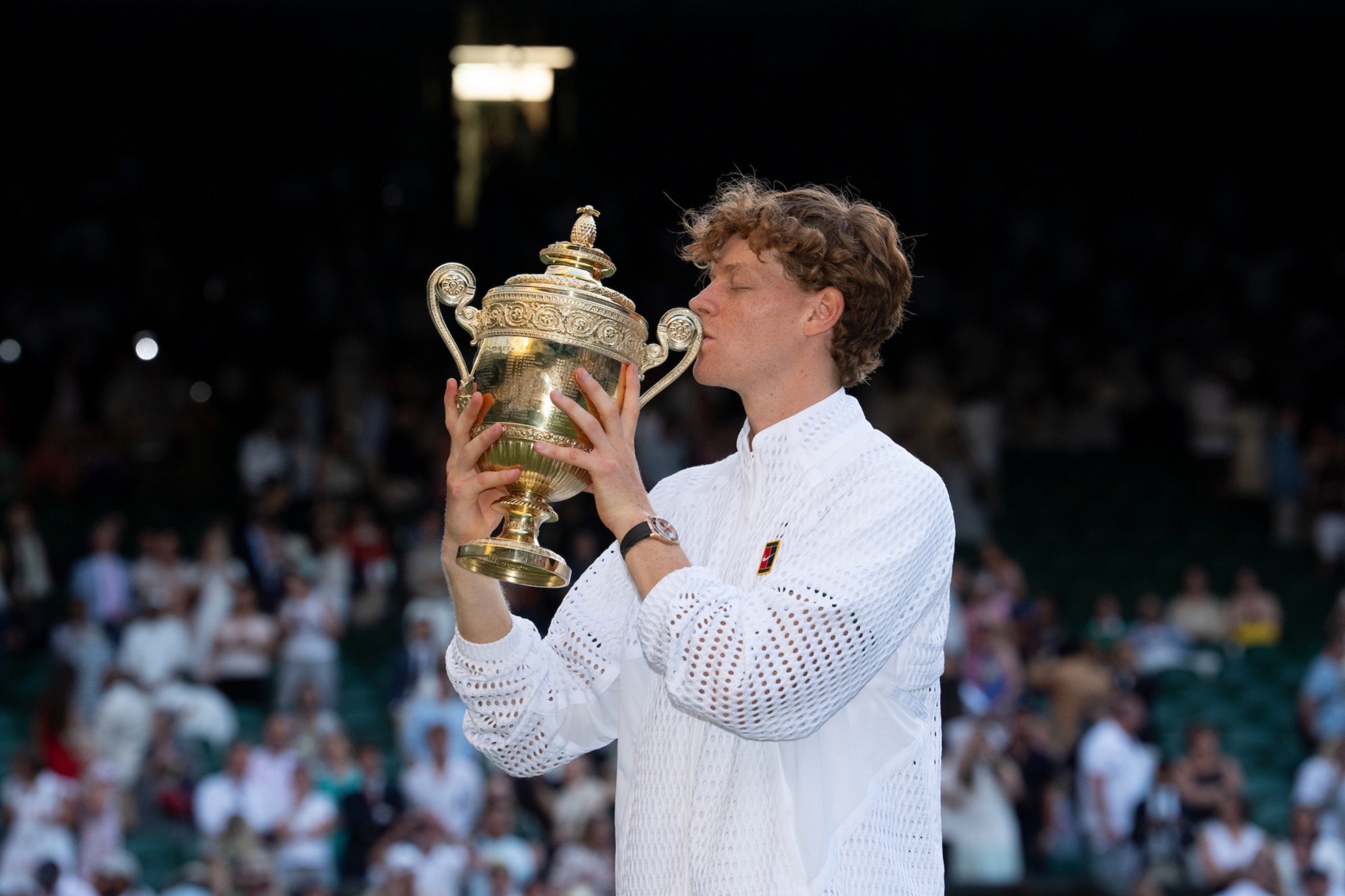
This Wimbledon trophy became Sinner’s fifth Grand Slam title and his second straight at the All England Club. In doing so, he joined the small group of men to have successfully defended the Wimbledon crown. Without Carlos Alcaraz across the net, few have found a way to disturb him at the top. Even Novak Djokovic, who again reached the semi-finals, could not complicate the Italian’s path. Sinner is moving through this phase of his career with a rare calm: not extraterrestrial, but strongly unbothered by the tour.
Zverev knew it, and there was little he could do about it. “He’s shown once again why he’s the best player in the world,” he said after the final. The US Open title will be the biggest test of the year to come, yet without Alcaraz, Sinner’s domination seems untouchable.
At 21, Linda Nosková, the quiet Czech from the small town of Prerov, became Wimbledon champion by defeating Karolína Muchová in an all-Czech final. The contest almost staged a remarkable comeback, but Nosková held her nerve against her compatriot to seal the title 6-2, 5-7, 6-3.
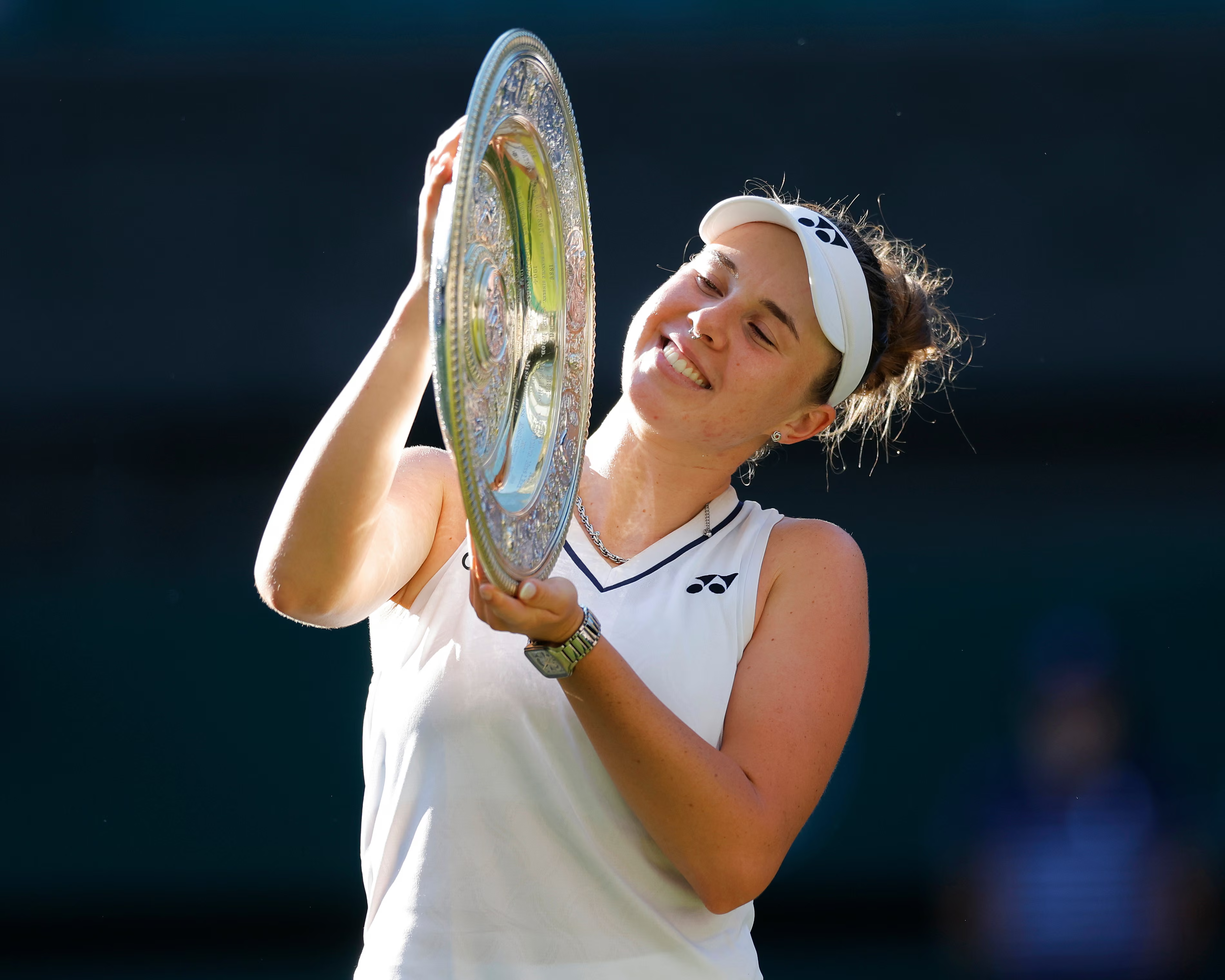
The match was anything but dull. From the opening exchanges, Centre Court and those watching beyond it were pulled into a final full of tension and shifting momentum. Nosková’s path had already been demanding: she faced Madison Keys in the fourth round and Marta Kostyuk in the semi-finals, beating both in straight sets. Yet this final carried a different weight. After last year’s swift dispatch of Amanda Anisimova by Iga Świątek, Wimbledon received the drama it had been waiting for. Nosková led 6-2, 5-2, held championship points, then watched five consecutive games slip away as Muchová dragged the match into a decider.
At Grand Slam final level, composure after things don’t go according to plan is everything. Nosková had to prove that resilience belonged to her game as much as power. She did. Her heavy serve and aggressive court position gave Muchová little room to disturb her in the third set, and the 21-year-old closed the encounter with a serve that felt like an ace. Afterwards, Muchová paid tribute to her opponent’s achievement: “You are so young, your first final and the way you handled it was really unbelievable.”
Now, attention turns to the Canadian Open, where Nosková is expected to arrive as world No.7 with a Wimbledon title under her arm. Not bad for a 21-year-old.