There is a sentence William Skinner, fifth-generation Managing Director of Dege & Skinner, says almost in passing, while explaining exactly what separates a bespoke suit from one simply made to measure, and which could well serve as the guiding principle of his entire trade. A two-piece suit, he explains, takes fifty to sixty hours of labour, far more than any factory could produce. “It does take a long time to produce a garment,” he says, “and I think that’s a pertinent point about coming to a bespoke tailor: it takes time, and there’s a reason for it.”
But the same sentence could be said, almost without adjustment, of everything else in this conversation: the years it takes to train a coat maker, the decades it takes to earn a client’s trust, the century and a half it has taken Dege & Skinner, at 10 Savile Row, to become what it is today. Nothing here was rushed. Nothing here was ever meant to be quick.
In most conversations, heritage is spoken of as something received and preserved, a fixed legacy kept safe behind glass. Skinner’s version of it is more restless than that, closer to something practised daily than something on display. “It comes down to sticking to one’s principles of making things well by hand, while rising to the challenges and new demands of today’s customers,” he says, when asked how a business endures, and stays relevant, across 160 years, with plenty more still to come.
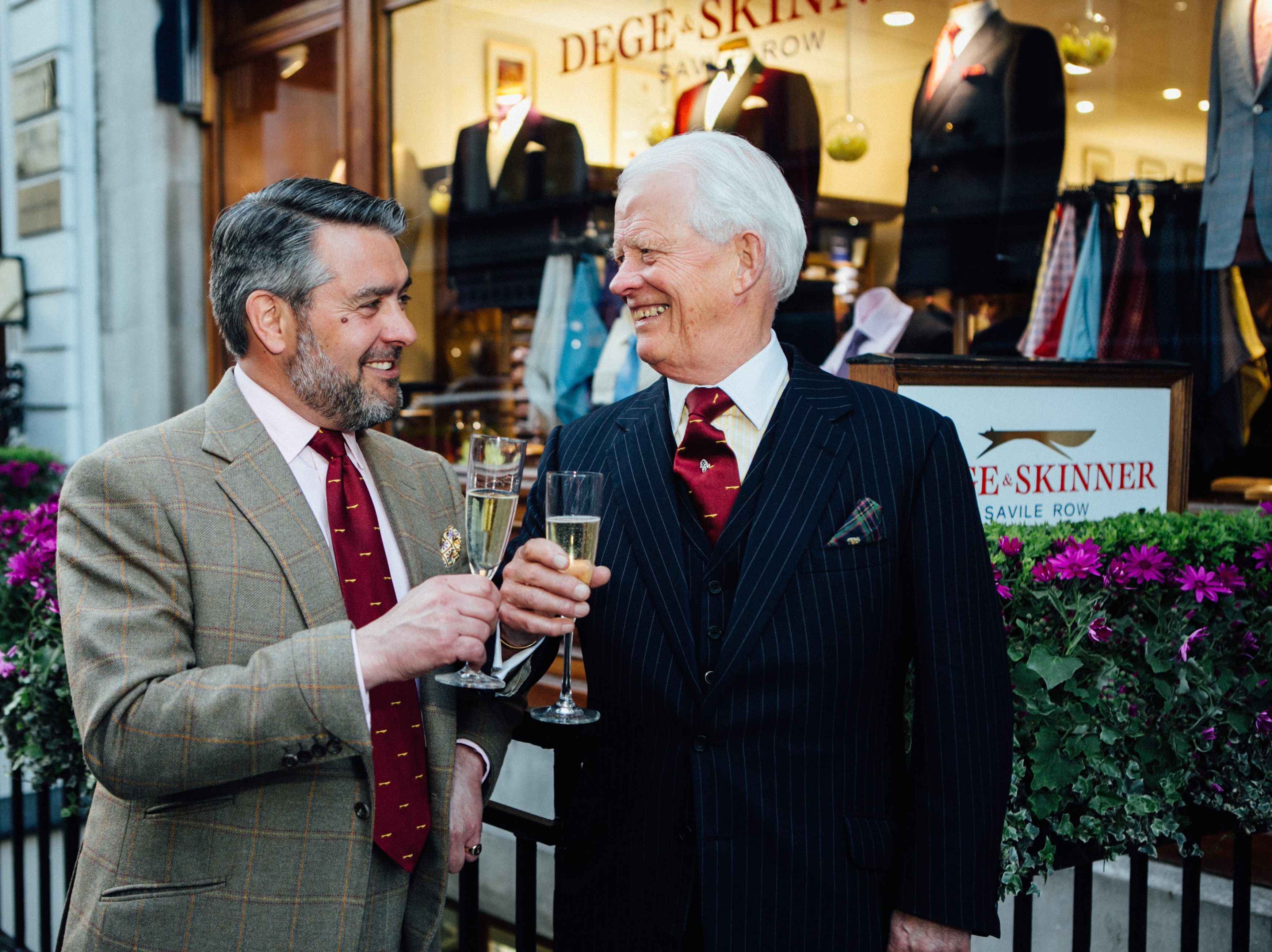
Dege & Skinner was founded in 1865, in an era when tailoring was a far more fractured trade than it is today. “Tailors tended to be specialists in one or two fields, either sporting clothing, military clothing, or dress clothing,” Skinner explains. “We were specifically riding specialists, a lot of riding britches and hunting clothes.” Then the motor car arrived, and with it, an entire way of dressing quietly disappeared.
The house adapted, as it would have to do again and again: through two world wars, the second of which saw the family’s premises bombed during the Blitz. “When my grandfather turned up to work one morning, there wasn’t much left of the building he’d left the night before.” Rather than close, Dege & Skinner opened satellite shops in garrison towns such as Aldershot and Catterick, dressing army officers through years when little else about London stood still.
Heritage, understood this way, is not the absence of change. It is the discipline of sticking to a principle while everything around it moves, and nowhere is that discipline more literal than in the garments themselves, which are not so much sold as they are built, individually, around the person who will wear them.
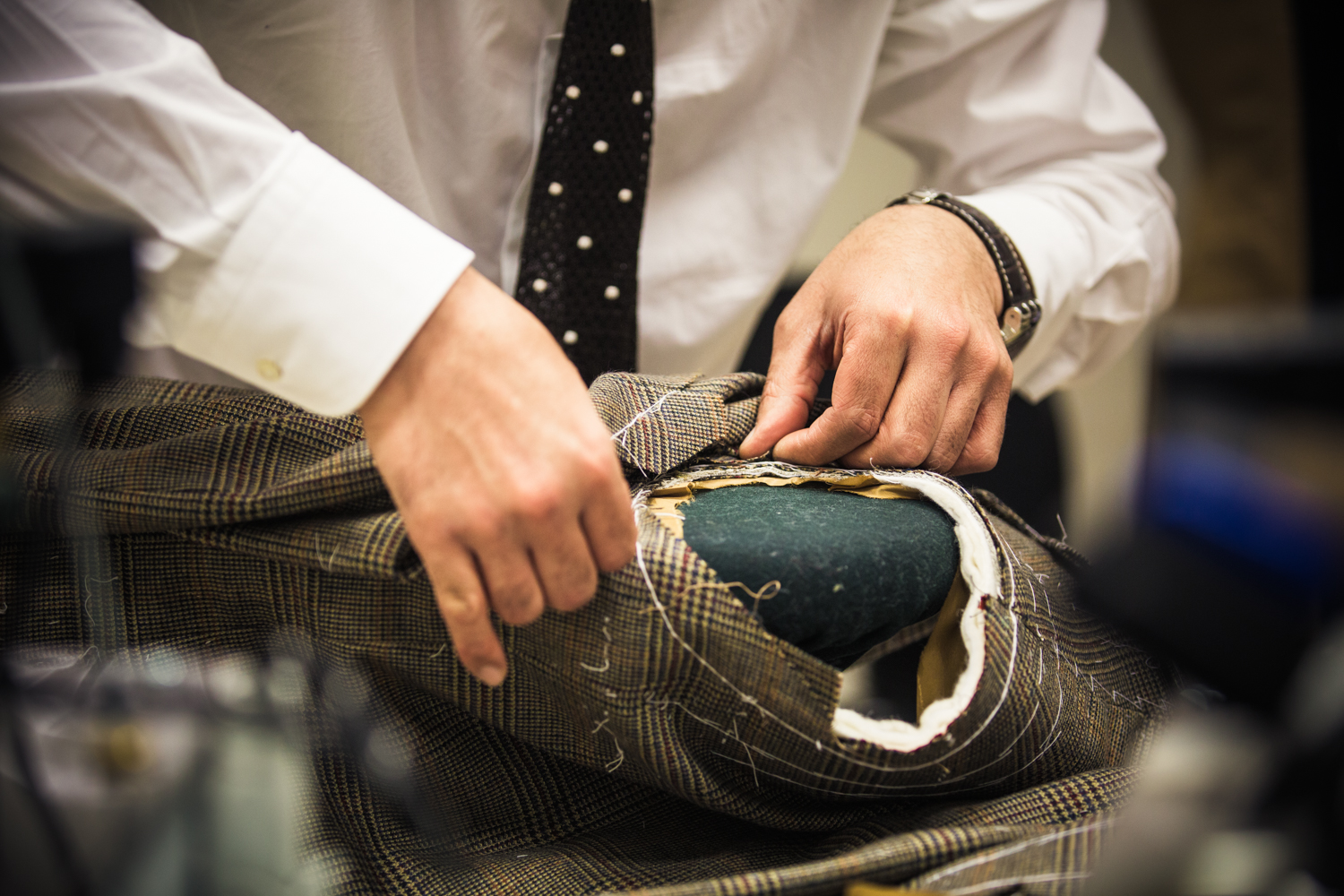
The bespoke process itself is simple to describe, less so to do: a customer’s measurements are taken and drafted into a pattern on stiff paper, a private map of one body. The cloth is cut, and a coat maker and trouser maker stitch the pieces loosely together for a first fitting, before the pattern is adjusted and the garment returns to the workshop, sometimes twice, occasionally more, before it is finished.

Made-to-measure, by contrast, is a factory process wearing a bespoke customer’s choices: the fabric and style are the client’s own, but the garment itself arrives largely finished, needing only minor alteration. “It’s a very different process once you understand it,” Skinner says, “and it reflects the time we spend making a suit.”
“We once made clothes for identical twins,” Skinner recalls. “They looked exactly the same, but their waist sizes were a bit different, and they were slightly different heights too. Quite an interesting case.”
None of this is possible without the craftspeople behind it, and Dege & Skinner treats their training with the same seriousness it applies to the cloth. Coat making takes three to five years to learn. Trouser making and waistcoat making take nearly as long. Roughly eighty per cent of the house’s craftspeople were trained on site, often beginning with a short internship designed, in part, to test their resolve. “It’s not that we try to put them off it exactly, but sometimes we do, just to test their integrity and their desire to do what they say they want to do. A bit of reverse psychology.”
Once trained, each craftsperson tends to find their own instinct within the trade. “Some people just want to make sports coats or sports jackets; some prefer to work with wool; others prefer trickier fabrics like velvet, where you can’t make a mistake, because you can’t brush it out if you crush it.” Those who make it through go on to sit the Savile Row Bespoke Diploma, an industry qualification awarded annually. The house’s own award ceremony took place only the Friday before this interview, with five certificates presented to craftspeople trained on site. “It’s rewarding to give that award,” Skinner says, “and see it reflect someone’s success in their ambition to do what they wanted to do.”
Even a diploma, in Skinner’s telling, is only the beginning of the education, not the end of it. “It’s like learning to drive. Once you pass your test, you really learn how to drive. The same philosophy applies to tailoring, and you always continue to learn, to face new challenges. That’s the beauty of it, no two days are the same.”

On Savile Row, mastery is not only a matter of the hands. It is also a matter of listening. “I think the main criterion for us is understanding what the customer is wearing the garment for, and where.” Skinner says. “That helps us hone in on which fabric is best, lightweight, heavyweight, durable, crease-resistant, or otherwise, and understand the client’s needs so we can advise accordingly, so he gets the maximum use from it.” A client who travels often needs a fabric that resists creasing, and often two pairs of trousers to go with it. A client who wears a suit for only a few hours at a time can afford something finer, since it will never need to be hard-wearing. “It’s advice like that, gleaned over many years, that we pass on, and people respect that point of view and come to us because they know we know what we’re doing.”
That relationship is, in practice, a chain of hands: “the person selling the suit, the person who measures you, your cutter who drafts your pattern, and then allocates the work to a coat maker and a trouser maker.” It is a structure that has scarcely changed since 1865, and Skinner is unsentimental about why it persists. “There’s a personal, physical interaction that you don’t always get elsewhere. We have to see people in person to do our job and create clothes, and that might become a challenge in years to come, with everything moving to arm’s length: buying everything from Amazon, driverless cars, and so on. The world will change, but I think it brings you back to ground zero: actually talking to people and having that personal relationship, which stands for a great deal.”
“It’s very much a living, symbiotic relationship between client and us,” is how he puts it elsewhere, and demanding clients, in that relationship, are simply part of the work. “It’s a case of learning how to deal with a demanding character. Putting forward a legitimate argument rather than just saying no. People don’t like hearing that word.”
Knowing a client that well eventually raises a harder question: how does anyone know, precisely, when a suit is finished? “It’s a combination of us being happy as the artisan and, just as importantly, the customer being happy, particularly if it’s their first bespoke suit.” Part of the work, in fact, is teaching a client to recognise the difference in the first place. “Sometimes people need to learn how a handmade suit feels. If you’re used to something off the rack, it will be looser fitting, deeper in the armholes, it fits where it touches. Whereas something made for you fits your body: your shoulders, your neck, your armhole, your sleeves, your stomach. It fits everything, and it’s all in proportion.”
.jpg)
The real reward, when it comes, tends to arrive somewhere else entirely, not in the workshop, but on the street. “The greatest accolade is when the customer walks out of the shop in his brand-new suit and is noticed or complimented on it, ‘that looks like a wonderful suit’, and you think, ah, it’s been noticed. That’s always a good feather in the cap, because they realise it was worth having clothes made.”
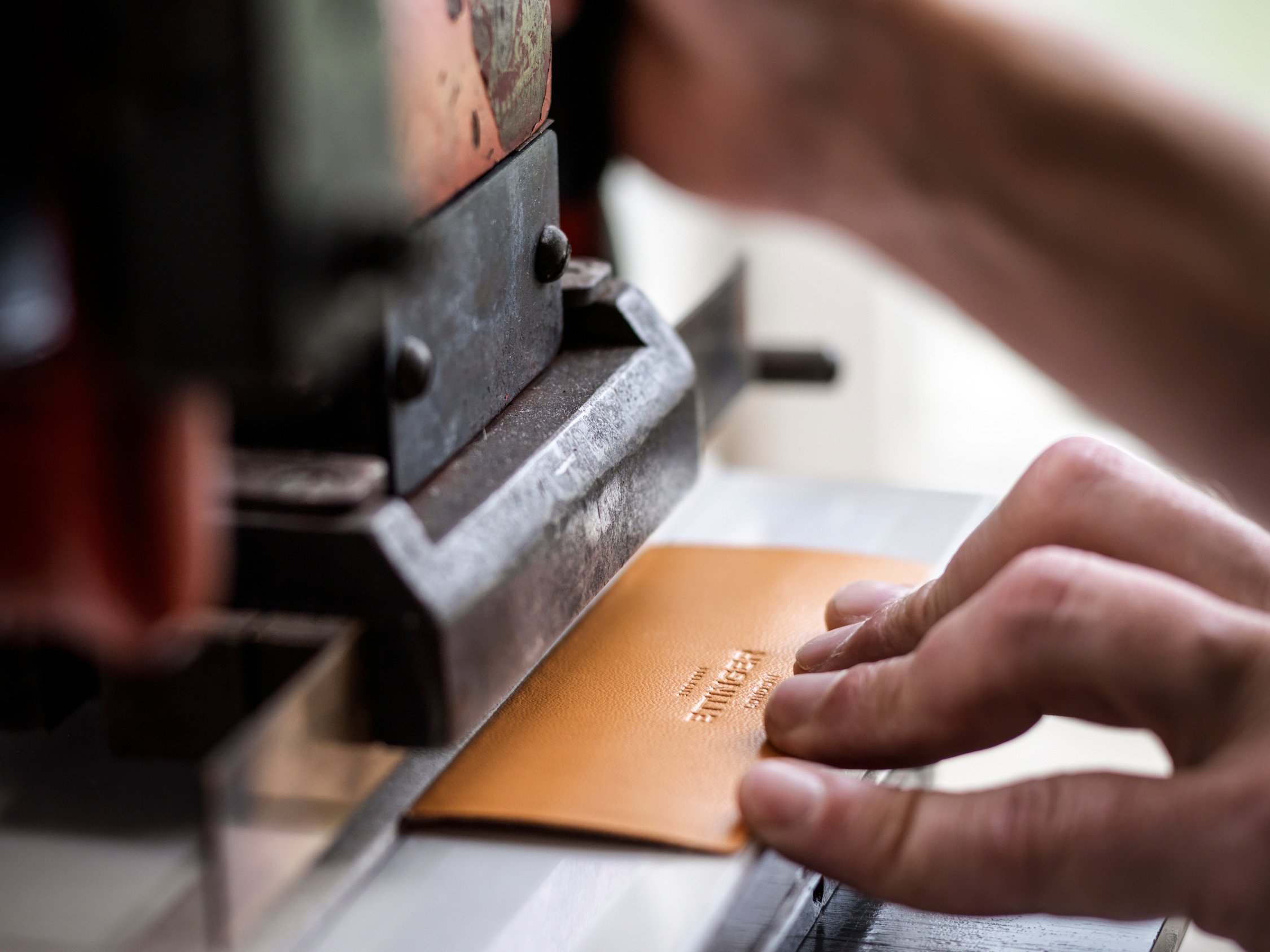
It is in the smallest, least visible details that Skinner locates the true signature of the craft. “The details are sometimes the unseen ones, how the suit is actually constructed in the first place, the work that goes into making the canvas. You’ll see it at the first fitting, but that’s the last time, because it’s then embedded inside the jacket, and that’s what gives the coat its shape, its form, its style, and its longevity.” Elsewhere, the discipline is entirely visible: buttonholes finished by hand, stripes matched precisely across a centre back seam, a collar aligned to a fraction of an inch. The aim, Skinner explains, is never to flatter a body into something it is not, but to bring it quietly into proportion. “It’s a subtle discretion.”
Asked what he would pass on to the next generation of tailors, Skinner does not pause. “Apply yourself from day one, and never give up.” Pressed on what has kept him excited after more than three decades in the same shop, he answers with something closer to a private philosophy than a professional one. “Don’t get stuck in a rut, and don’t get single-minded. Be open to, and listen to, other people.” He might, in the end, have simply been repeating himself. It takes time, and there’s a reason for it.

Once again, I’m delighted to share another story worth telling. This one has left me personally enriched, and I’ll leave it with words often attributed to the art critic John Ruskin: “Quality is never an accident; it is always the result of intelligent effort.”