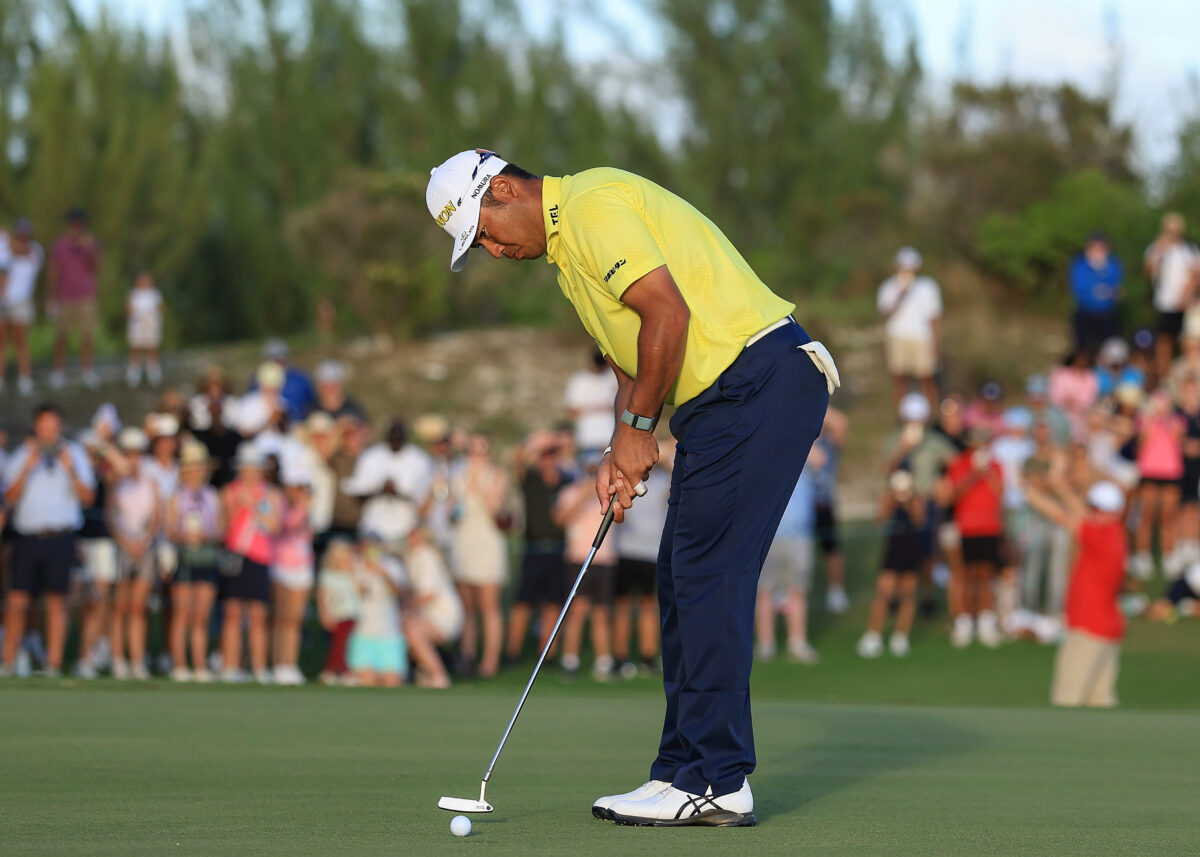
Hideki Matsuyama’s playoff win over Alex Noren at the Hero World Challenge was a fittingly precise ending to a week defined less by chaos than by controlled aggression and fine margins. For an invitational that often acts as a laboratory for trends at the top of the men’s game, 2025 delivered a clear message: elite golf is increasingly about managing scoring races at 20-under and beyond, not surviving par.
The final board read like a who’s who of current form players, but it also reflected distinctly skilled profiles. Matsuyama and Noren reached 22-under, with Sepp Straka one back at 21-under and both Scottie Scheffler and J.J. Spaun tied at 20-under. These athletes overwhelmingly underline just how narrow the performance band is when conditions are gettable and the field is only 20 deep. Justin Rose at 18-under and Corey Conners at 17-under rounded out a top tier that combined efficient ball-striking with opportunistic par‑5 scoring rather than flawless golf.

Matsuyama’s closing 64 will live in the highlights, but the win was built on sequencing more than streaks. He started Sunday three behind and front-loaded his move with birdies on two of Albany’s early par 5s, then used the hole‑out from the fairway on 10 as a pivot point rather than a turning point into all‑out attack. From there, he effectively played defense with the lead, accepting pars on the final five holes while leaning on his approach play to avoid stress. This was a conservative finish, underscoring trust in his baseline ball‑striking rather than his putter.
Noren’s path to the playoff underscored how elite putting can still shift the balance in a ball-striker’s week. His closing stretch, from the look at eagle on 15 to the make on 16 and the decisive birdie on 18, showed a player leaning on feel and rhythm rather than altering the foundations of his tee-to-green game.
Straka, by contrast, rode an ultra‑aggressive front nine (32 shots) and a third‑round 64. He then paid for a single loose swing with a bogey at 16 on Sunday, which was a reminder that, at Albany, a minor miss with an iron can erase 63‑level golf in one hole.
For Scheffler, a tie for fourth at 20-under is less a failure than a recalibration point in a tournament he had won twice in a row. The week reinforced a familiar pattern: Scheffler can contend even when slightly off, but in a 20‑man sprint his putting volatility means any lull, like the missed birdie on 17 on Sunday, turns a potential three‑peat into a respectable but forgettable finish.
As a continuation of this year’s earlier pieces on Albany, this edition confirmed themes that had been building across the week: the course still rewards high‑end iron control, creative scoring on par 5s and the ability to stay patient while others flash lower single rounds. More broadly, the Hero World Challenge again previewed a 2026 landscape in which the sport’s top tier is defined less by who can go lowest once, and more by who can turn that level into a reliable ceiling in made‑for‑TV, small‑field shootouts.