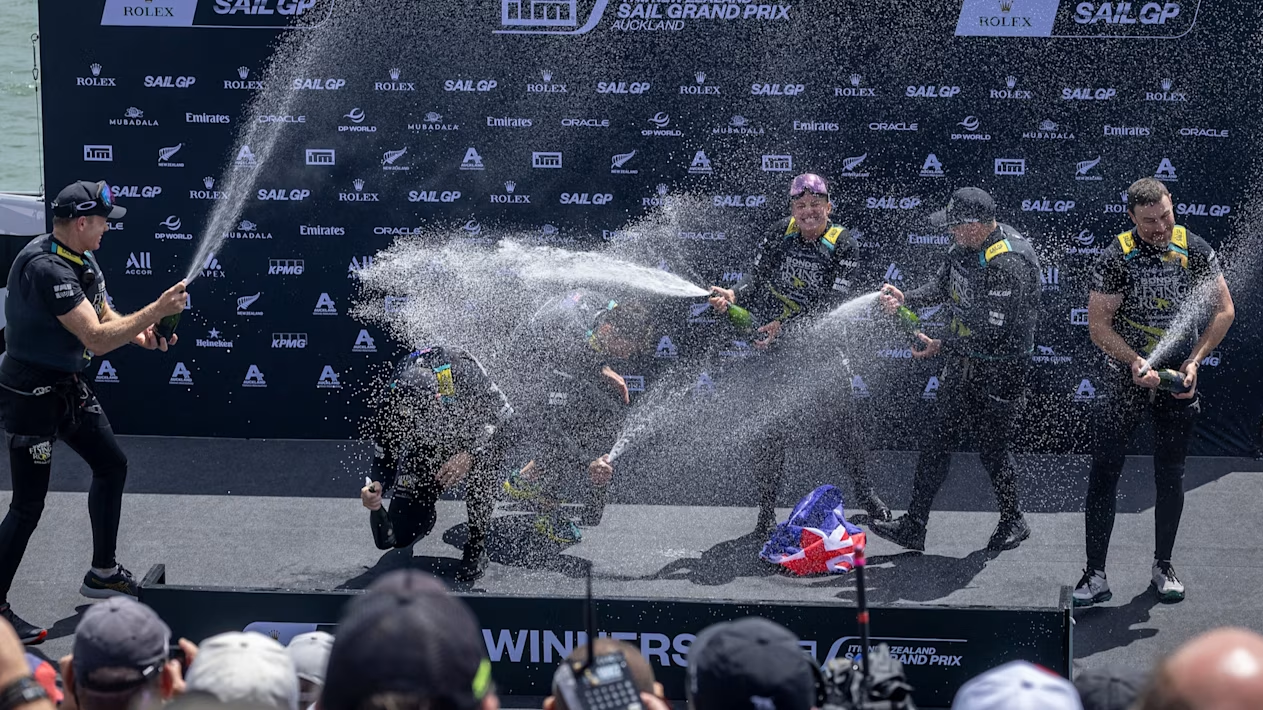
The ITM New Zealand Sail Grand Prix in Auckland, the second event of the 2026 Rolex SailGP Championship season, will be remembered for a collision that reshaped the entire weekend. Australia left with the trophy, but the defining image was the crash between the New Zealand Black Foils and France’s DS Automobiles SailGP Team during Saturday’s third race.
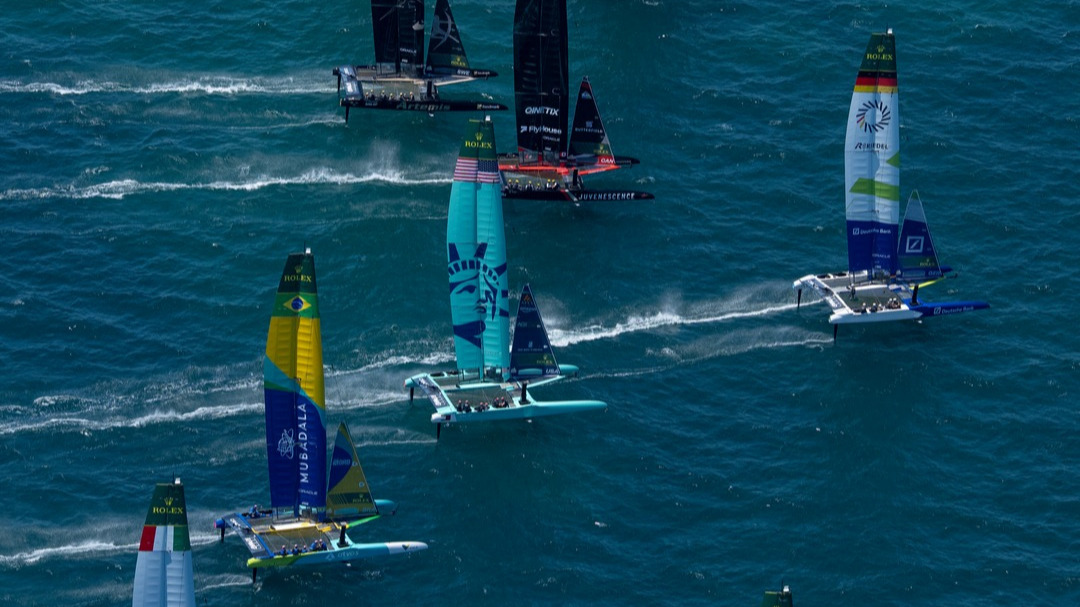
The incident unfolded just seconds after the start, on the opening reach towards Mark 1. With 13 F50s charging down a tight, stadium-style course on the Waitematā Harbour and gusts pushing close to 32 km/h, speeds were touching 93.7 km/h, around 50.5 knots. New Zealand had lined up to the windward of France. As the fleet accelerated, the Kiwi F50 appeared to ride unusually high on its foils. The rudder lost grip and the boat began to skid sideways to leeward. It then snapped head-to-wind, its bow digging in, and came almost broadside directly in front of the French boat.
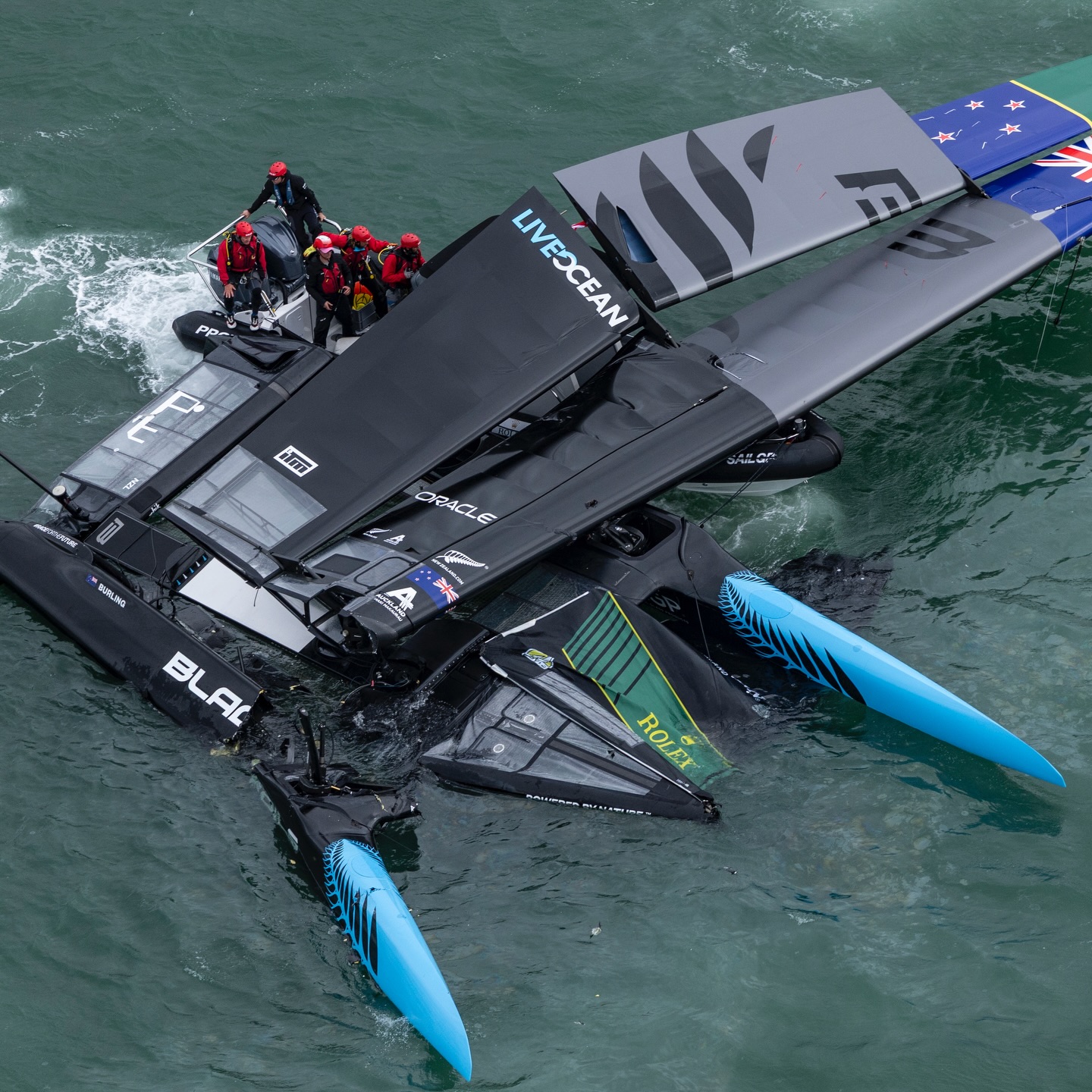
On such a confined racecourse there was nowhere for France to go. The port hull of the French F50 struck the starboard hull of the Amokura at shroud level in a heavy, unavoidable impact. The French boat briefly rode up onto the New Zealand structure. Racing was abandoned immediately as safety teams rushed to both crews.
Two sailors were injured. Louis Sinclair, grinder for the Black Foils, suffered compound fractures to both legs and was taken to hospital in Auckland, where he was reported stable while receiving treatment. On the French side, strategist Manon Audinet was thrown forward by the force of the collision, breaking the team’s port-side steering wheel in the process. She too was hospitalized and reported stable. All other crew members were quickly accounted for without serious injury.
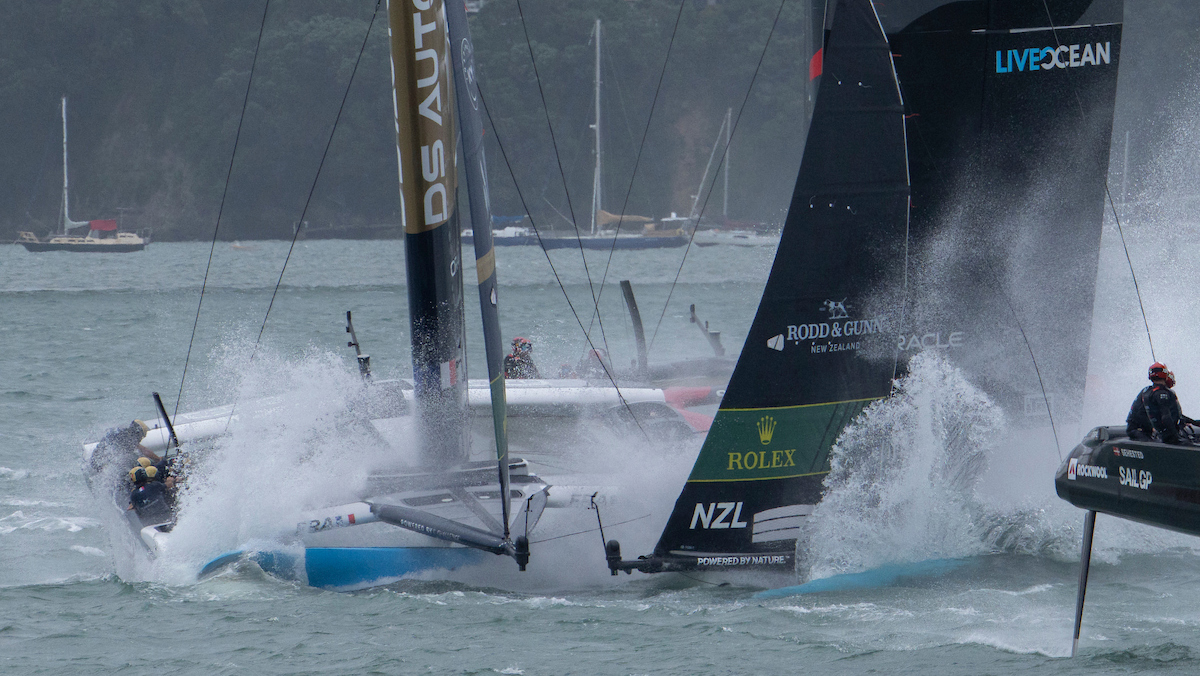
The sporting consequences were significant. New Zealand, who had finished third and first in the opening two races and were leading the event at the time, were handed an eight-point penalty by the umpires. In addition, Peter Burling received points on his SailGP Super Licence under the league’s new disciplinary framework. Both France and New Zealand were ruled out for the remainder of the weekend while SailGP Technologies assessed the structural damage to their F50s.
Saturday’s remaining races were cancelled. With even stronger winds forecast for Sunday, organisers introduced a split-fleet format for the first time in order to reduce congestion on the tight course and improve safety. With 11 boats available, the fleet was divided according to the provisional standings.
Group A comprised Emirates GBR, Germany by Deutsche Bank, Mubadala Brazil, NorthStar and Red Bull Italy. Group B featured BONDS Flying Roos, Los Gallos, ROCKWOOL Racing, Artemis, Switzerland and the U.S. SailGP Team.
Each group sailed two races in an alternating sequence, A, B, A, B, making four fleet races in total. Teams scored within their own group, with the top three overall advancing to the winner-takes-all Final. The Final decided positions one to three, while places from fourth downward were determined by comparing results within each group and applying tie-break criteria based on the most recent race and prior standings if required.
In that revised format, Australia capitalised. The BONDS Flying Roos, helmed by Tom Slingsby, progressed from their group into the Final alongside Emirates GBR and Los Gallos, the only three teams in the fleet to have won a SailGP championship. In demanding conditions, the decisive moment came at the windward mark, where Australia secured inside overlap and control. From there they managed the race to the finish, claiming their first Grand Prix victory in a year and moving to the top of the overall standings after two events, level on 19 points with Emirates GBR.
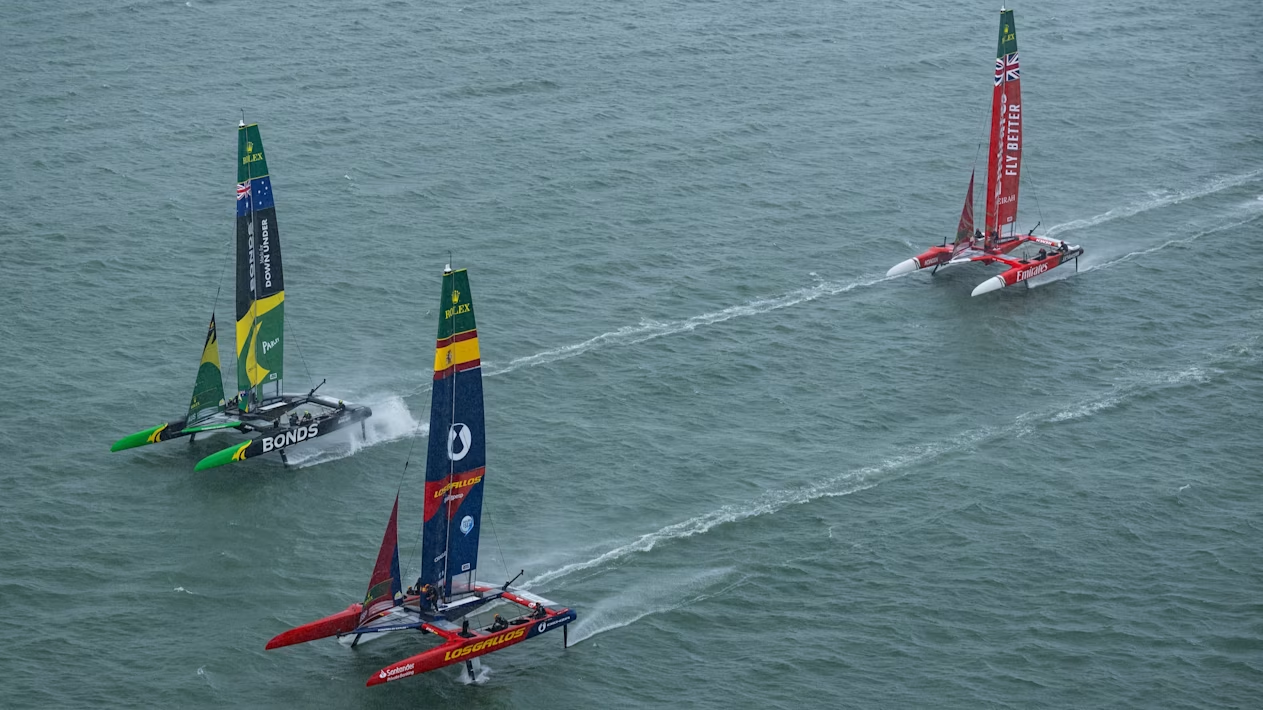
Attention now turns to Sydney. The KPMG Sydney Sail Grand Prix will take place on 28 February and 1 March, the final Southern Hemisphere stop before the season continues elsewhere. For Australia, racing at home carries added weight. The Auckland win ends a year-long wait for a Grand Prix title and puts them at the head of the table, yet recent seasons have shown that success in Sydney is far from guaranteed.
For New Zealand and France, Sydney raises practical and competitive questions. Beyond the recovery of Sinclair and Audinet, the extent of structural repairs and the turnaround time between events will be decisive. The calendar leaves little margin.
Auckland underlined both the speed and the fine margins that define SailGP. Australia departs with momentum, Britain remains firmly in contention, and the rest of the fleet will look to close the gap. The championship moves on.
See you in Sydney.